
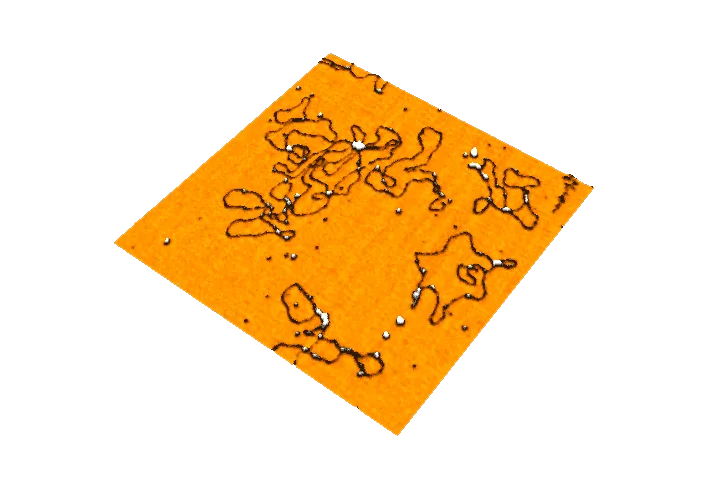
Application fields
Key Features
Oscillating Mode
- High-Sensitivity Phase Contrast: Detect subtle variations in material properties.
- Wide Bandwidth Frequency: Accommodate various cantilever types and sample requirements.
- Integrated Lock-in Amplifier: Ensure precise amplitude and phase measurements.
- Low Contact Forces: Minimize sample damage and tip wear.
- Versatile Imaging: Suitable for both soft and hard samples.
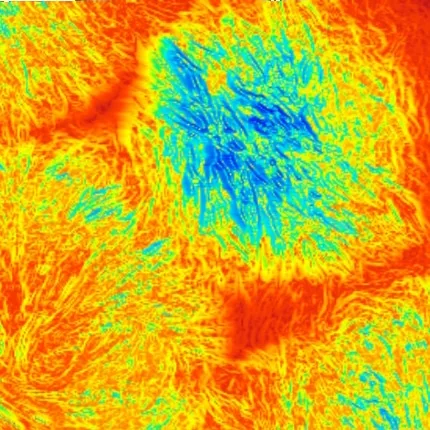
Scan size 20µm x 20 µm
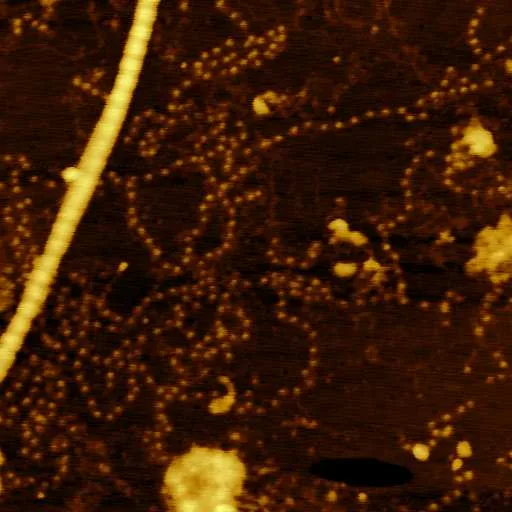
Scan size 2 µm x 2 µm
Benefits of Oscillating Mode AFM
- Superior Resolution: Our advanced implementation offers high spatial resolution and sensitivity.
- User-Friendly Interface: Intuitive software makes Oscillating Mode AFM accessible to both experts and beginners.
- Versatility: Easily switch between Oscillating Mode and other AFM modes for comprehensive sample characterization.
- Expert Support: Our team of specialists provides ongoing support and training.
- Cutting-Edge Research: Stay at the forefront of nanoscale characterization with our continuously updated technology.
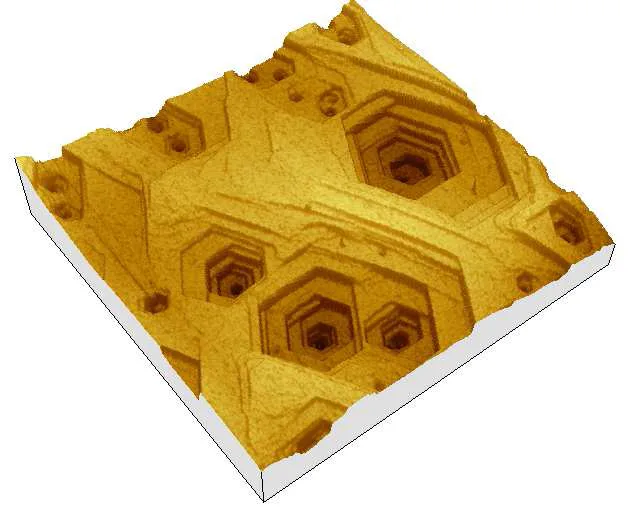
Scan size 3 µm x 3 µm
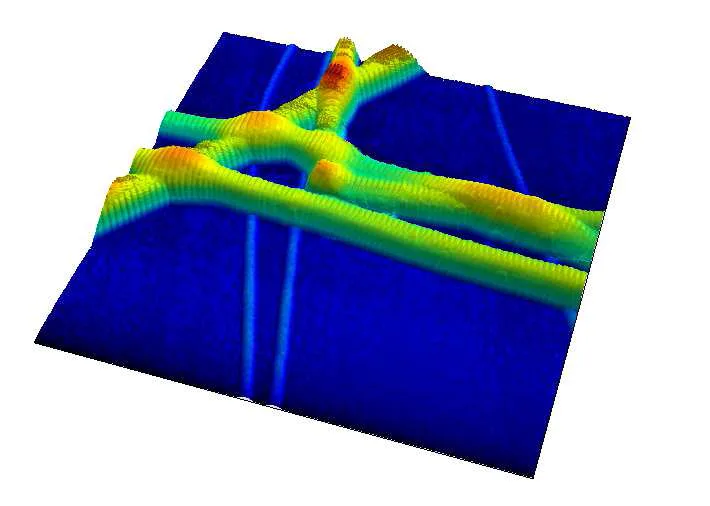
Scan size 5µm x 5 µm
How does Oscillating Mode work?
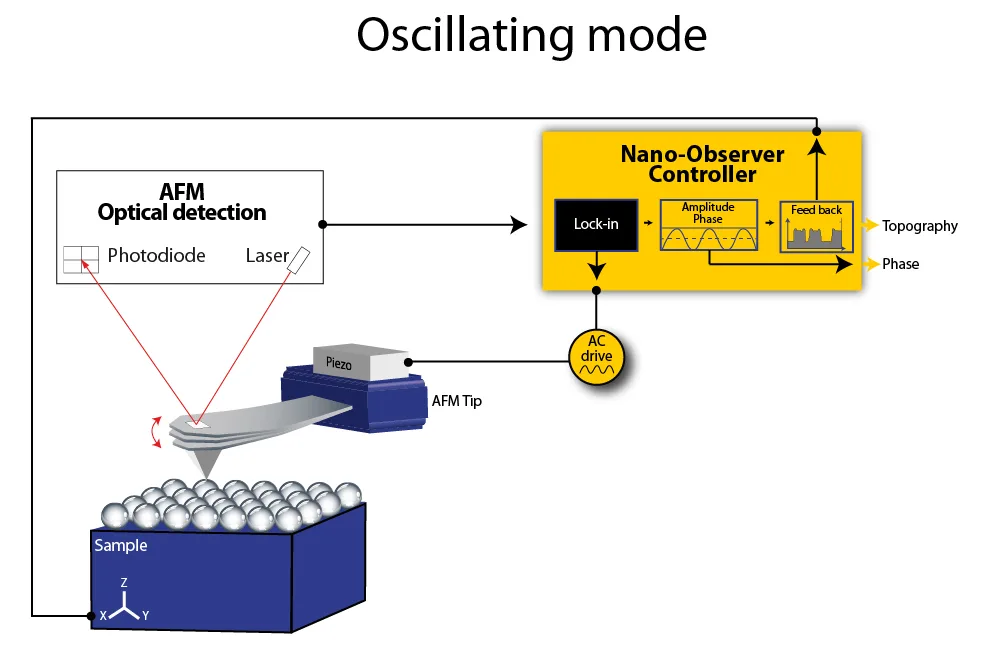
- Tip Vibration: A cantilever tip vibrates at or near its resonant frequency.
- Surface Interaction: As the tip approaches the sample surface, interactions cause changes in the oscillation amplitude and phase.
- Feedback Control: The system maintains a constant oscillation amplitude by adjusting the tip-sample distance.
- Data Acquisition: Vertical adjustments are recorded to create a topographic image, while phase shifts provide information on mechanical properties.
Specifications
- Frequency Range: 1 kHz – 2 MHz
- Typical Oscillation Amplitude: 20 – 100 nm
- Phase Sensitivity: < 0.1°
- Compatible with all CSInstruments AFM systems
- Optional: Advanced spectroscopy modules for force curve analysis
Application Fields
Polymers
- Morphology of blends, copolymers and composites with phase contrast — even when the topography is flat
- Spherulites and crystallization, in situ with temperature control
Biology
- Proteins and collagen fibres, at low force and in liquid
Materials science and nanostructures
- Topography and roughness of hard and soft surfaces
- Nanostructured and patterned surfaces
Basis for other modes
- Topography pass of MFM and lift-mode KFM; first eigenmode of single-pass HD-KFM
FAQ
Frequently Asked Questions
Is resonant (oscillating) mode the same as tapping mode?
Yes. In resonant mode — also called tapping, oscillating or AC mode — the cantilever vibrates at or near its resonant frequency; interactions with the surface change the oscillation amplitude and phase, and the feedback keeps the amplitude constant by adjusting the tip–sample distance.
What does the phase image show in tapping mode?
The phase shift of the oscillation follows how the tip interacts with each material — stiffness, adhesion, dissipation — so different components appear with different contrast, even on a flat surface.
Tapping mode or contact mode?
Tapping mode applies low contact forces and no dragging, which suits soft samples and limits tip wear; contact mode keeps the tip in contact and is used for hard samples and as the basis of lateral force, conductive and piezoresponse measurements.
Questions about Oscillating Mode?
Ask the application scientists behind our AFMs and modes — about your samples, probes, set-up or which mode fits your measurement. We answer every message personally.