
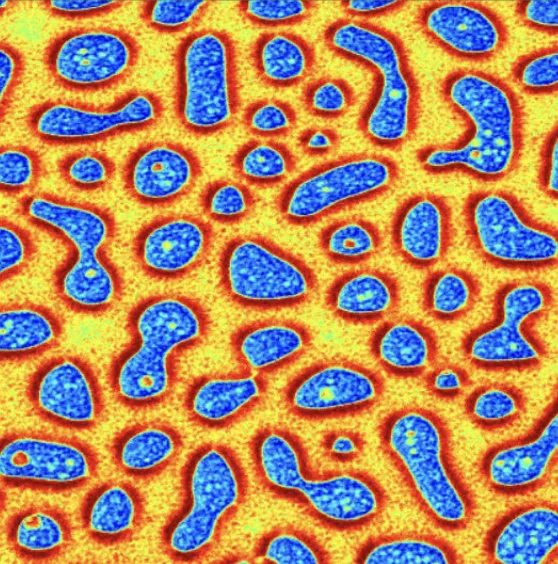
PS/PMMA image 5×5 micron
Application fields
Key Features
Force Modulation
- Mechanical Property Imaging: Map stiffness, elasticity, and viscoelastic behavior with high resolution.
- Nanoscale Sensitivity: Detect subtle mechanical variations at the sub-nanometer scale.
- Wide Applicability: Suitable for hard and soft materials in diverse environments.
- Non-Destructive Testing: Perfect for delicate samples like biological tissues and thin films.
- Multimodal Compatibility: Combine with other AFM modes for comprehensive analysis.
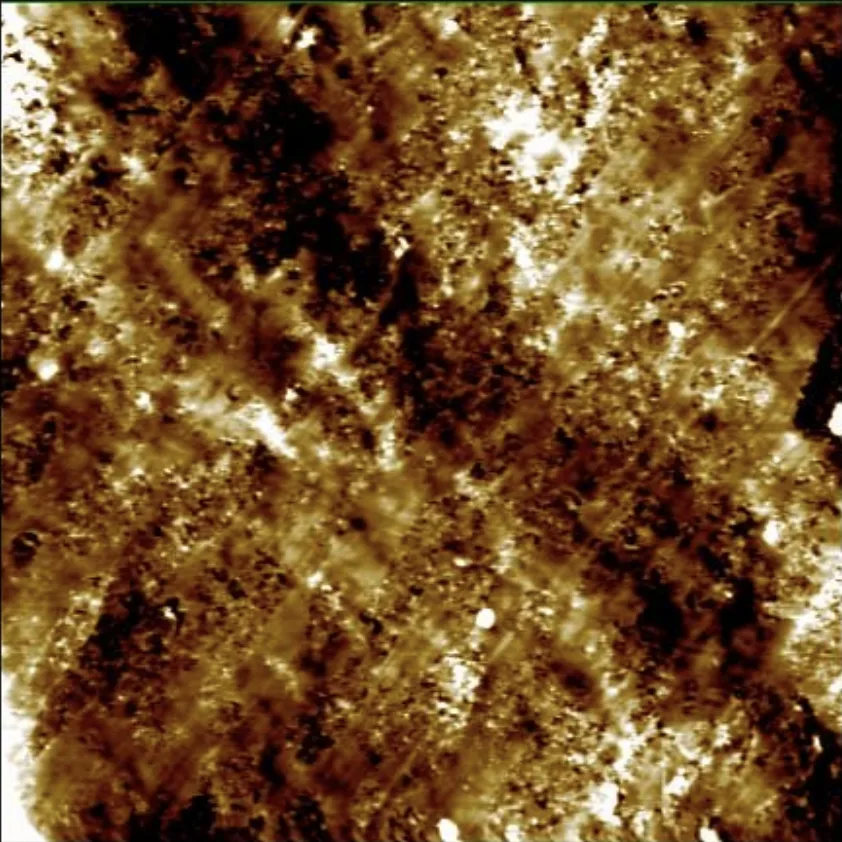
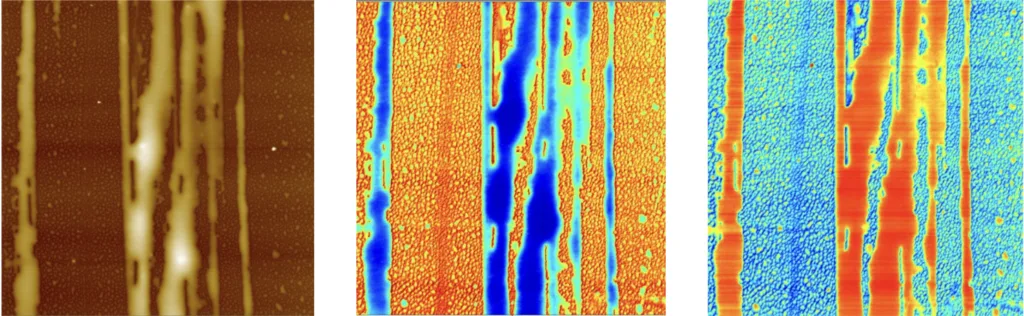
Block Polymer
Scan size 50 µm x 50 µm
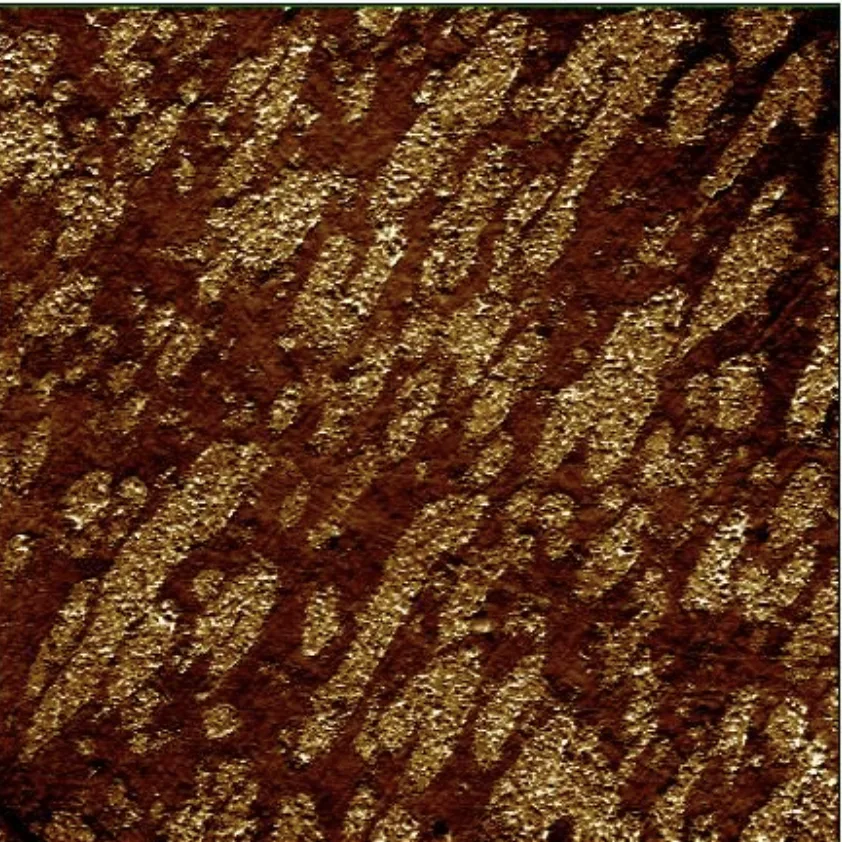
Block Polymer
Scan size 50 µm x 50 µm
Applications of Force Modulation Mode
Polymers and Nanocomposites
- Map stiffness and elasticity variations in polymer blends.
- Analyze nanoscale heterogeneity in composite materials.
Thin Films and Coatings
- Measure mechanical properties of thin films without damaging the surface.
- Evaluate adhesion and elasticity in functional coatings.
Biological Samples
- Characterize the mechanical behavior of cells and tissues.
- Investigate biomaterial elasticity for medical applications.
How does Force Modulation AFM work?
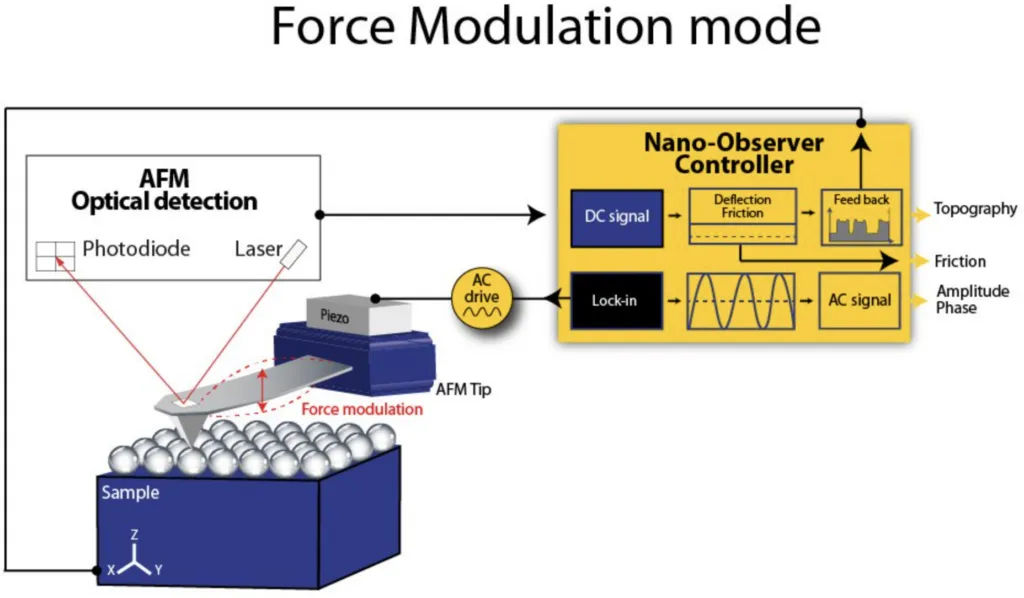
Force Modulation Mode operates by oscillating the AFM probe vertically while maintaining contact with the sample surface. The tip-sample interaction response provides a map of the sample’s mechanical properties, such as stiffness and viscoelasticity, in real time.
Specifications
- Frequency Range: Up to hundreds of kHz for mechanical property mapping.
- Displacement Control: Sub-nanometer precision.
- Operating Environments: Air, liquid, and controlled atmospheres.
- Applications: Polymers, composites, biological tissues, and thin films.
Going further
Soft MEKA — the same measurement, without shear
Force modulation keeps the tip in contact while it oscillates. On soft, sticky or weakly attached samples that shears the material and mixes topography into the mechanical signal. Soft MEKA does the same job in intermittent contact: one controlled touch per point, a full force curve at every point, and quantitative stiffness, Young’s modulus and adhesion maps — without dragging anything across the surface.
Questions about Force Modulation Mode?
Ask the application scientists behind our AFMs and modes — about your samples, probes, set-up or which mode fits your measurement. We answer every message personally.