
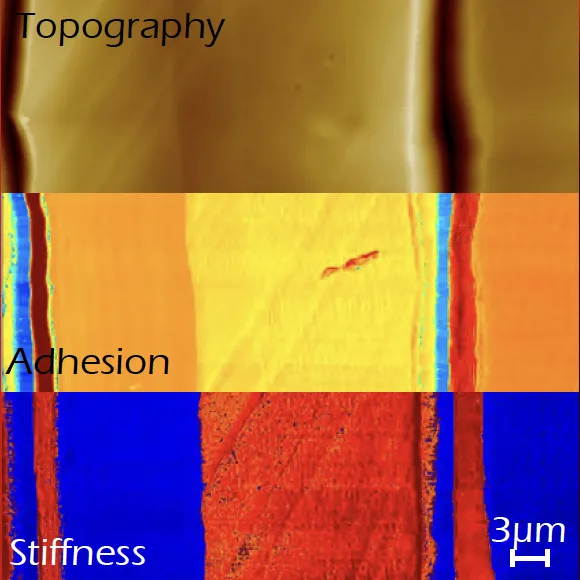
How it works
One touch per point, one force curve per point
- At every pixel the tip approaches the surface, touches it with a set force and retracts.
- The lift height is larger than the adhesion force, so the tip fully disengages between points — no lateral force, no shear, nothing dragged across the surface.
- The force curve of each point gives the contact stiffness and the pull-off (adhesion) force.
- The stiffness channel is converted into Young’s modulus with the software module.
- Because the force is controlled directly, the same settings hold from hard to very soft areas.
This is the difference with force modulation, where the tip stays in contact and is oscillated: on soft or weakly attached material that mixes topography into the mechanical signal and can damage the surface.
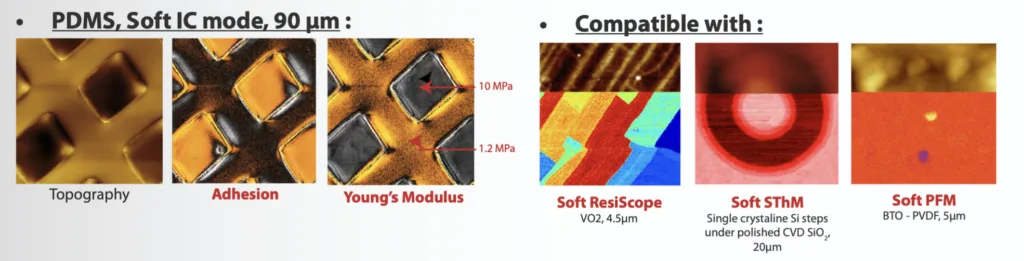
What you measure
Three correlated channels in a single pass
Topography
Height image recorded with direct force control, free of the friction and shear artefacts of contact mode.
Adhesion
Pull-off force at every point, in force units — surface chemistry, contamination, release layers and binder distribution.
Stiffness → Young’s modulus
Contact stiffness at every point, converted to Young’s modulus for quantitative elasticity maps.
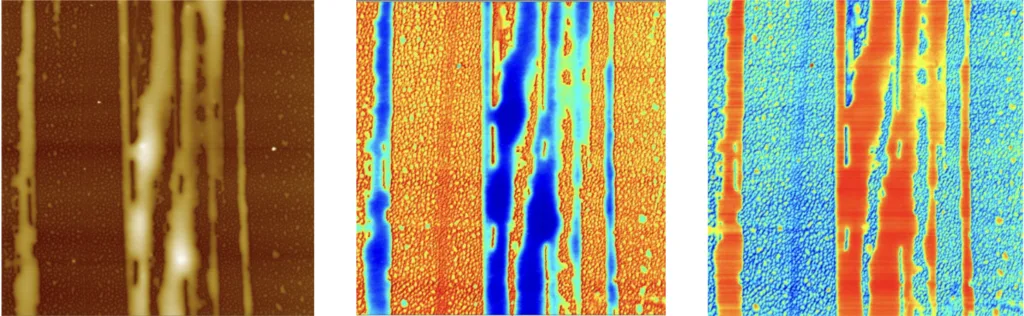
Every point keeps its force curve, so the maps can be re-analysed afterwards instead of being reduced to a single contrast image.
Which mechanical mode
Soft MEKA, force modulation or nano-indentation?
Force modulation
Fast relative contrast between stiff and soft areas on robust samples. The tip stays in contact, so it is not suited to fragile or sticky surfaces.
Soft MEKA
Quantitative stiffness and adhesion maps with no shear, at imaging resolution. The mode for polymers, gels, biological films and loose particles.
Nano-indentation & force spectroscopy
Single-point measurements when you need deep indentation curves or a full force–distance study rather than a map.
Where it is used
Samples that standard contact mode would damage
- Polymers and blends — phase separation, crystallinity and filler distribution, with stiffness instead of phase contrast.
- Adhesives, release layers and coatings — adhesion mapped in force units across the surface.
- Hydrogels and biological films — elasticity of soft, hydrated material.
- Composites — fibre–matrix interfaces and interphase width.
- Battery electrodes — binder against active material, together with Soft ResiScope™ on the same area.
- Loose particles and powders — measured without pushing them around.
Soft MEKA runs on the Nano-Observer II and can be added to an existing AFM with the Galaxy Dual Controller.