
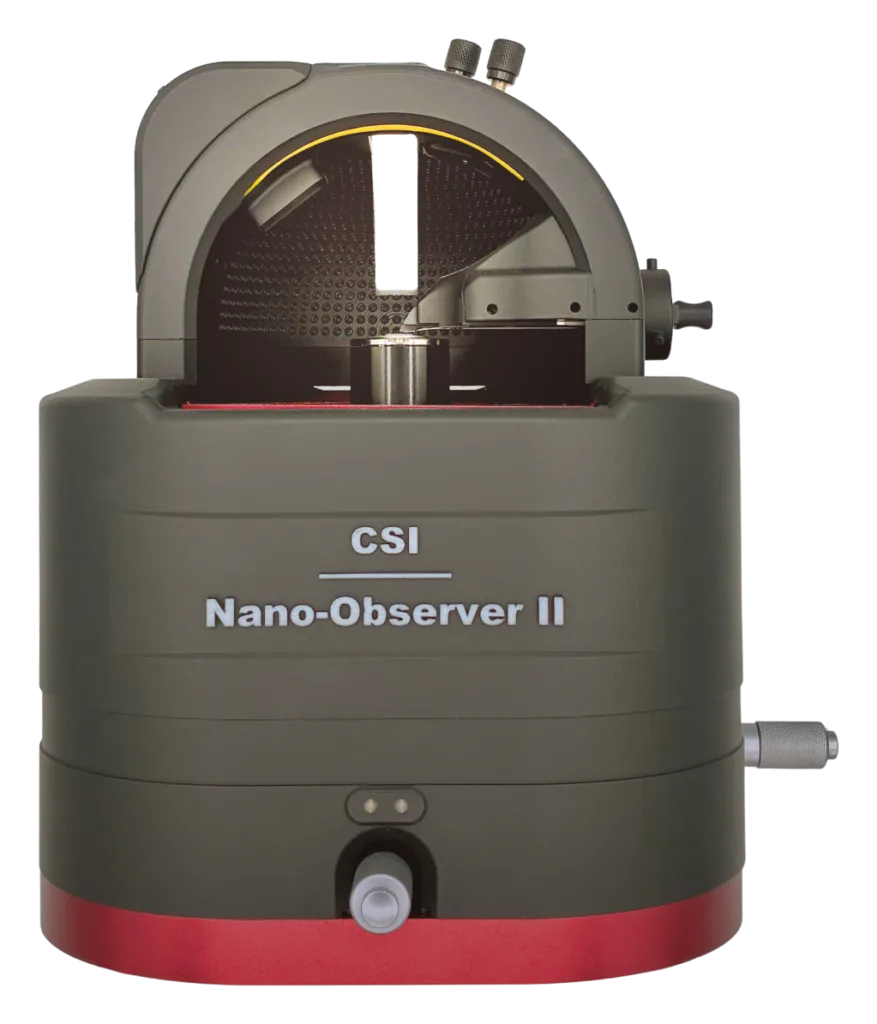
Nano-Observer II
A full research atomic force microscope with more than 20 modes on one head and the third generation of our electrical modes built in.
- ResiScope™ III: resistance from 10² to 10¹² Ω in one scan
- HD-KFM™ III: surface potential on the second eigenmode
- 100 × 100 µm XY, 15 µm Z, 24-bit Galaxy USB controller
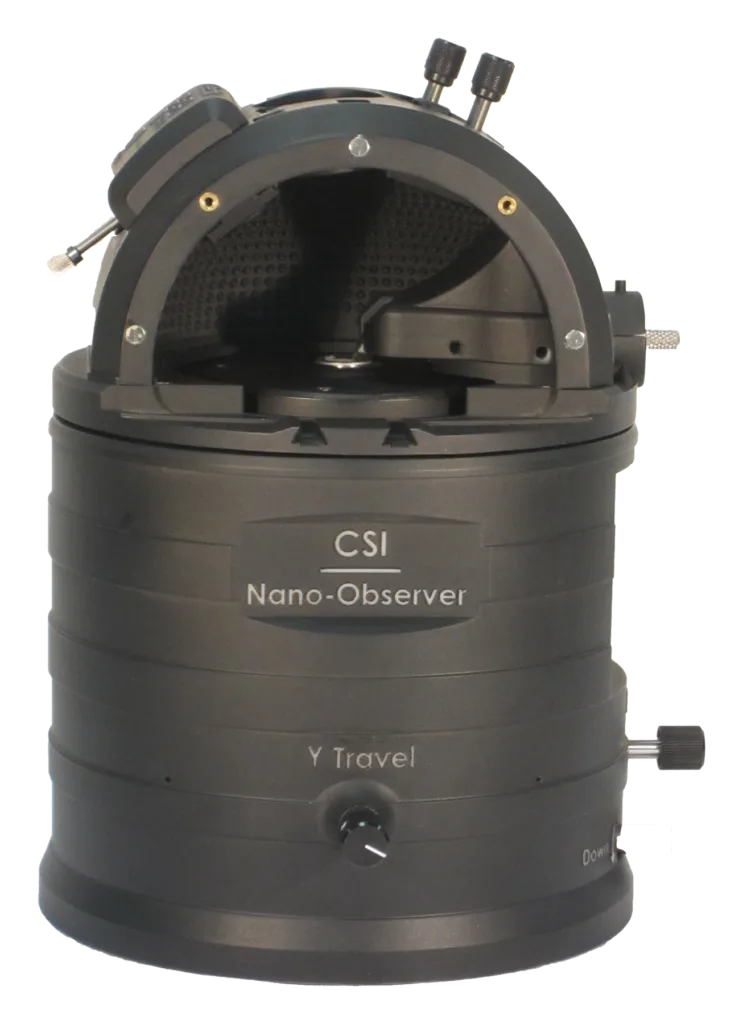
Nano-Observer One Plus
An atomic force microscope for imaging and the main electrical, mechanical and magnetic modes, with the same scan range as the Nano-Observer II.
- ResiScope™ II: 10² to 10¹² Ω, 50 fA to 1 mA
- HD-KFM™ I: second-eigenmode KPFM
- 100 × 100 µm XY, 15 µm Z, 24-bit control
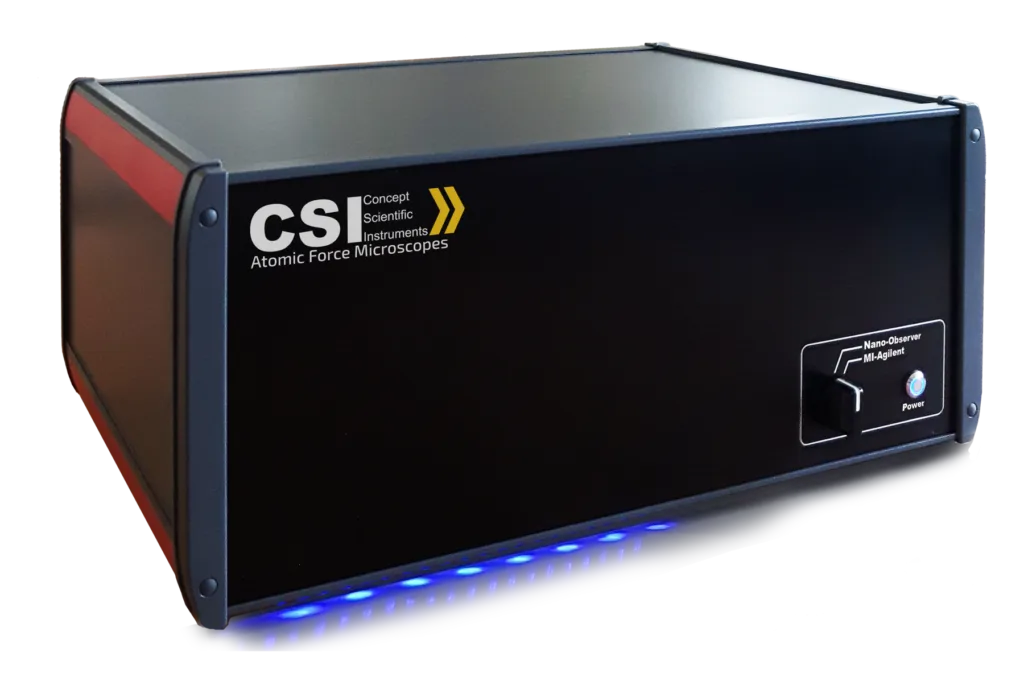
Galaxy Dual Controller
Upgrades an atomic force microscope you already have. It keeps the existing modes (STM, contact, AC, phase, MFM, EFM, PFM, LFM, EC) and adds our own.
- For MultiMode, Dimension 3000/3100, Pico SPM
- For Agilent / Keysight 5100, 5500, 5600LS and 54xx
- Adds ResiScope™, Soft ResiScope™, HD-KFM™, Soft Interaction Control
Choose
Which atomic force microscope for your research?
- Electrical measurements on new samples (conductive AFM, SSRM, KPFM, PFM): the Nano-Observer II, with ResiScope™ III and HD-KFM™ III.
- Imaging and the main modes in teaching, quality control or a first AFM lab: the Nano-Observer One Plus.
- You already have a MultiMode, Dimension or Agilent AFM: the Galaxy Dual Controller adds our modes to it.
- Batteries, perovskites or air-sensitive samples: the Nano-Observer II with glovebox use or the illumination arm.
Not sure which mode your sample needs? See how to choose the right AFM mode or AFM by material.
AFM basics
What an atomic force microscope measures
An atomic force microscope (AFM) builds a 3D image of a surface by scanning a sharp tip, a few nanometres wide at its apex, over the sample. It works in air, in liquid or in a glovebox, on conductive and insulating samples alike, and needs no vacuum and no coating.
Topography is only the first channel. With the same tip, atomic force microscopy also maps how a material conducts, how charges and work function vary, how it responds to a voltage or a magnetic field, and how stiff or sticky it is. That is why AFM is used across semiconductors, batteries, solar cells, 2D materials, polymers and biology.
Our Nano-Observer atomic force microscopes are built around two modes we developed ourselves: ResiScope™, conductive AFM that measures resistance over ten decades in one scan, and HD-KFM™, Kelvin probe force microscopy on the second eigenmode of the cantilever. Browse every mode on the AFM modes page and real results in the AFM scan gallery.
CSInstruments
A European atomic force microscope manufacturer
- Designed and built in France. CSInstruments designs and builds the Nano-Observer AFMs in Les Ulis, France (EU).
- Our own modes. ResiScope™, Soft ResiScope™, HD-KFM™ and Soft Intermittent Contact are developed in house.
- New system or upgrade. A complete Nano-Observer, or the Galaxy Dual Controller for the AFM you already have.
- Tested on your sample. Our application team can run test measurements on your sample before you decide.
- Support. Help with your instrument, its software or a mode, online or on site: see services and support.








FAQ
Atomic force microscope questions
How does an atomic force microscope work?
An atomic force microscope (AFM) scans a sharp tip at the end of a flexible cantilever across the surface. A laser reflected from the back of the cantilever onto a photodiode measures how the cantilever bends or how its oscillation changes, and a feedback loop keeps that interaction constant, which records the topography line by line. Electrical, magnetic and mechanical modes read other signals with the same tip.
What can an atomic force microscope measure?
Topography at the nanoscale, and with the right mode: local resistance and current (ResiScope™, C-AFM), surface potential and work function (HD-KFM™, KPFM), piezoresponse (PFM), magnetic domains (MFM), electric fields (EFM), and nanomechanical properties such as stiffness and adhesion.
How much does an atomic force microscope cost?
There is no public price list. The quotation depends on the configuration: the system, the modes you add (ResiScope™ III, HD-KFM™ III, nanomechanical, magnetic, thermal, environmental) and options such as the illumination arm, glovebox use, AFM-IR or the motorized stage. Request a quote with your application and we send a configuration and its price.
What is the difference between the Nano-Observer II and the Nano-Observer One Plus?
Both have a 100 × 100 µm XY and 15 µm Z scanner. The Nano-Observer II has more than 20 modes on one head and the third generation of our electrical modes, ResiScope™ III and HD-KFM™ III, with options such as the illumination arm and glovebox use. The Nano-Observer One Plus has ResiScope™ II and HD-KFM™ I.
Which atomic force microscope for conductive AFM or KPFM?
For conductive AFM and spreading resistance, ResiScope™ III measures from 10² to 10¹² Ω in one scan without changing the gain by hand. For KPFM, HD-KFM™ III measures the surface potential on the second eigenmode of the cantilever, at 350–400 kHz. Both come with the Nano-Observer II, and the Galaxy Dual Controller adds ResiScope™ and HD-KFM™ to a MultiMode, Dimension or Agilent AFM.
Can I upgrade my existing atomic force microscope?
Yes, if it is a MultiMode, Dimension 3000/3100, Pico SPM or an Agilent / Keysight 5100, 5500, 5600LS or 54xx. The Galaxy Dual Controller replaces the controller, keeps the existing modes and adds ResiScope™, Soft ResiScope™, HD-KFM™ and Soft Interaction Control.
Can you test my sample before I choose an AFM?
Yes. Tell us about your material and what you need to measure; our application team picks the mode and can run test measurements on your sample, then sends the results with a Nano-Observer configuration or a Galaxy upgrade that fits your lab.
What specs matter most when buying an AFM?
Start from the measurement: the modes you need (topography, electrical, mechanical, magnetic). Then check the scan range and whether the scanner is closed loop, the sample size the stage accepts, the environment (liquid, temperature, gas or glovebox) and whether modes can be added later. For reference, the Nano-Observer II has a 100 × 100 µm closed-loop XY scanner with a 15 µm Z range, a 24-bit controller, more than 20 modes on one head, and takes samples up to 52 mm in diameter.
Get a quote or a test on your sample
Tell us your application and the samples you measure. We reply with a configuration and its price, or with test results on your sample.