
Soft Interaction Control
The switch happens mid-scan
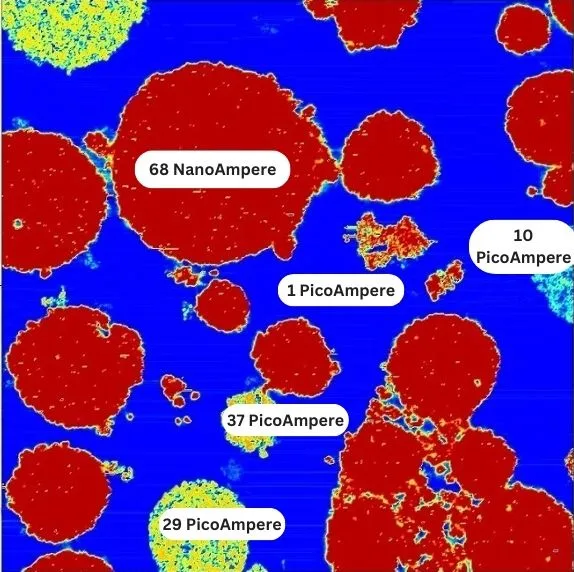
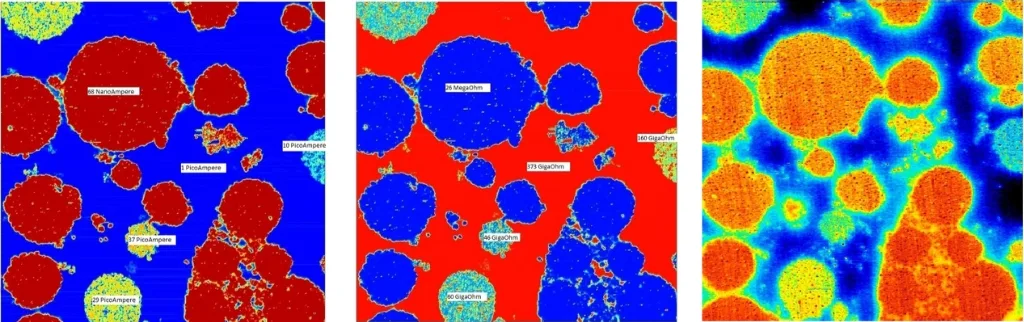
On a battery electrode, the scan changes from contact ResiScope to Soft Interaction Control halfway through — Soft IC improves the measurement without scratching the surface.
- No shear on the particle, no scratching
- Structure inside the particle becomes readable
- Resistance — 314 kΩ to 902 GΩ
Application fields
Key Features
Soft IC mode
Contact-mode control, resonant-mode gentleness
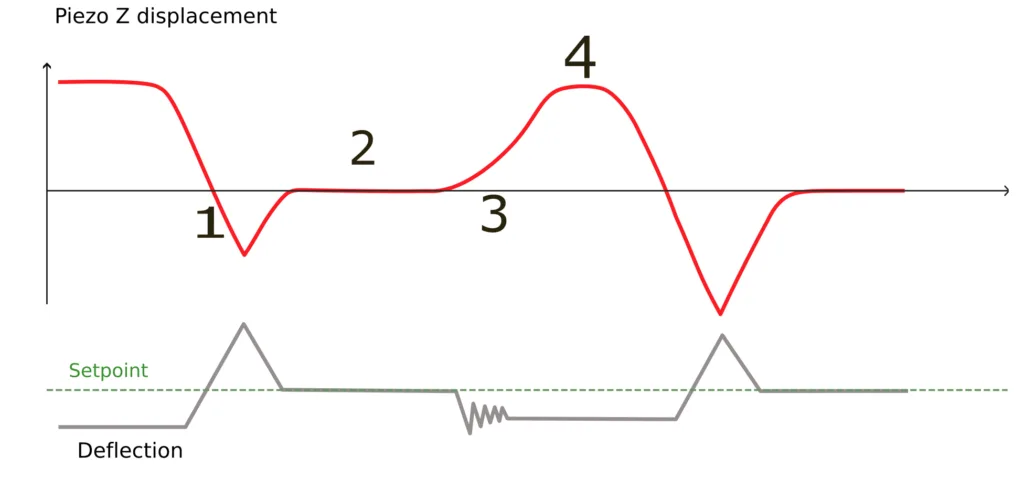
In Soft Interaction Control the tip touches the surface once per point with a force set directly through the cantilever deflection, then lifts away before moving on. The force is known and identical at every point, and no lateral force is applied to the sample.
- Direct force control: one parameter, the deflection; the force follows from Hooke’s law
- No friction or shear: the tip is never dragged across the surface
- Less damage, longer tip life: soft, sticky and loosely bound samples stay intact
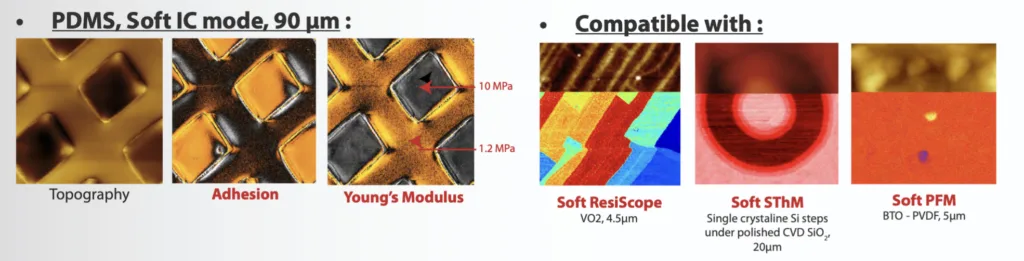
- Quantitative channels: topography, stiffness, adhesion and electrical signals from the same touch
Compared with contact mode
- No lateral forces
- Less sample damage
- Longer tip lifetime
Compared with resonant (tapping) mode
- Force controlled directly, with a single parameter
- Force calculated directly, not inferred from an amplitude
- More straightforward operation
How it works
Four steps at every point
- Topography and stiffness — the tip approaches and touches the surface; height and contact stiffness are recorded.
- Constant force — the same maximum force at every point makes the measurements quantitative.
- Adhesion — on retraction, the pull-off force is measured.
- Next point — the tip lifts clear of the surface and moves on without any lateral force.
Electrical, piezoelectric and thermal measurements are made during the contact: Soft ResiScope™, C-AFM, PFM and SThM all run in Soft IC, and Soft MEKA turns the force curves into stiffness, adhesion and Young’s modulus maps.
Soft Modes
Soft MEKA
Mechanical Properties Analysis:
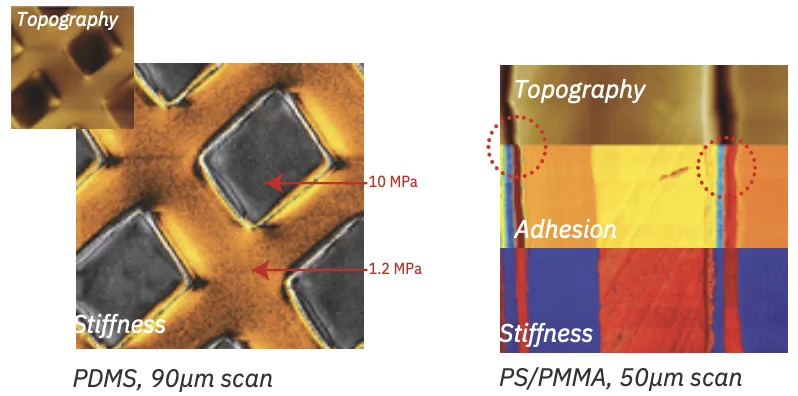
- Extension of Soft IC mode for precise mechanical measurements
- High-resolution mapping capabilities
- Specially designed for soft/fragile samples
Key Capabilities:
- Precise stiffness mapping
- Detailed adhesion measurements
- Force curve analysisMechanical property extraction
Soft ResiScope
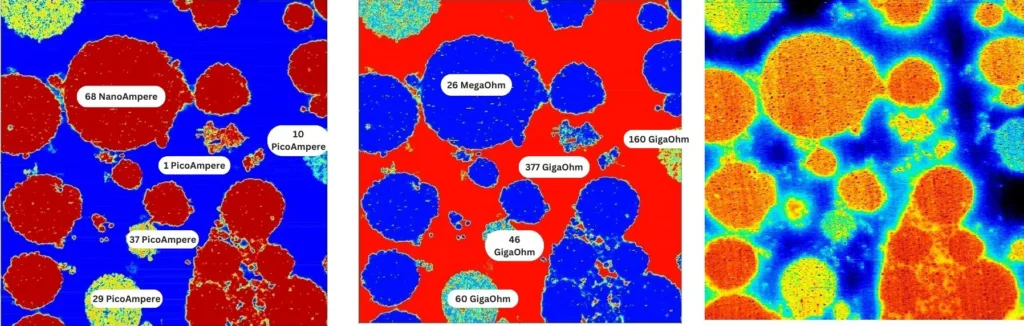
Resistance & Current Analysis:
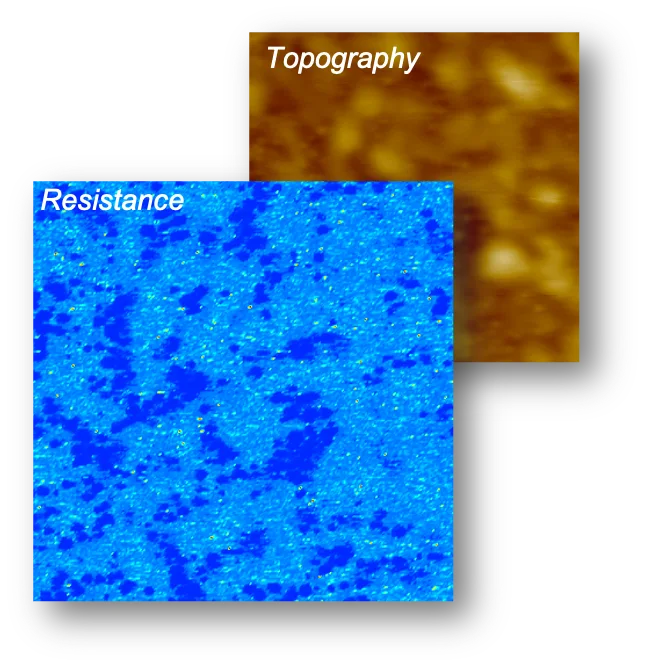
- Non-destructive measurements on fragile and soft conductive samples
- Resistance from 10² to 10¹² ohms
- No friction — prevents sample damage and tip wear
- Constant force for quantitative electrical measurements
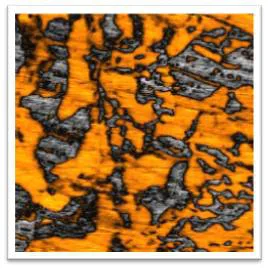
Soft PFM
Piezoelectric Measurements:
- High-sensitivity piezoresponse detection
- Local polarization mapping
- Domain structure analysis
- Minimal sample perturbation
Key Benefits:
- Enhanced sensitivity for weak piezoresponse
- Reduced tip and sample wear
- Better signal-to-noise ratio
- Compatible with sensitive materials
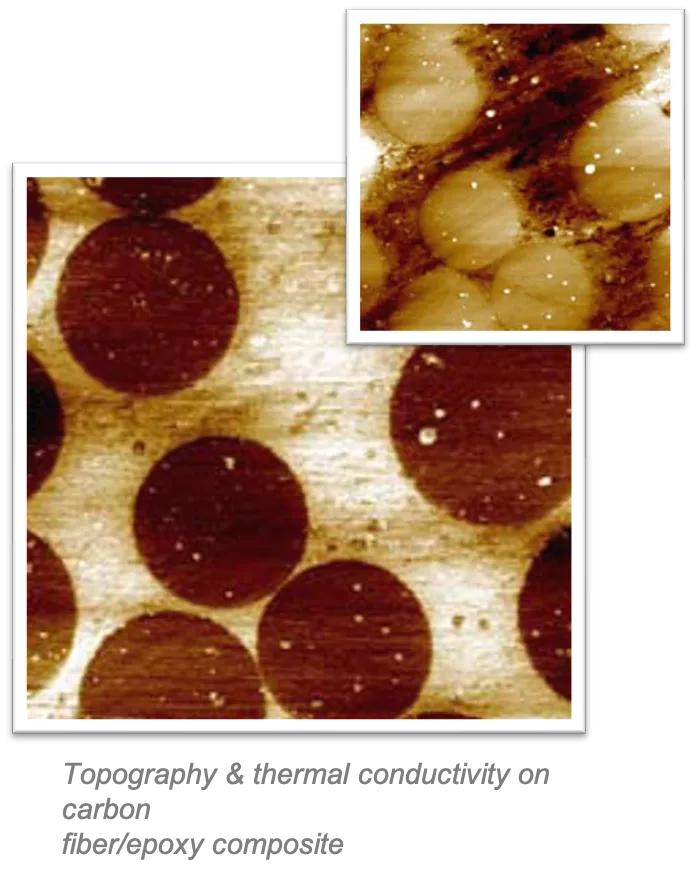
Soft SThM
Thermal Analysis Features:
- Temperature mapping with nanoscale resolution
- Local thermal analysis
- Minimal thermal perturbation
Applications:
- Polymer characterization
- Thermal interface materials
- Microelectronics inspection
- Biological samples
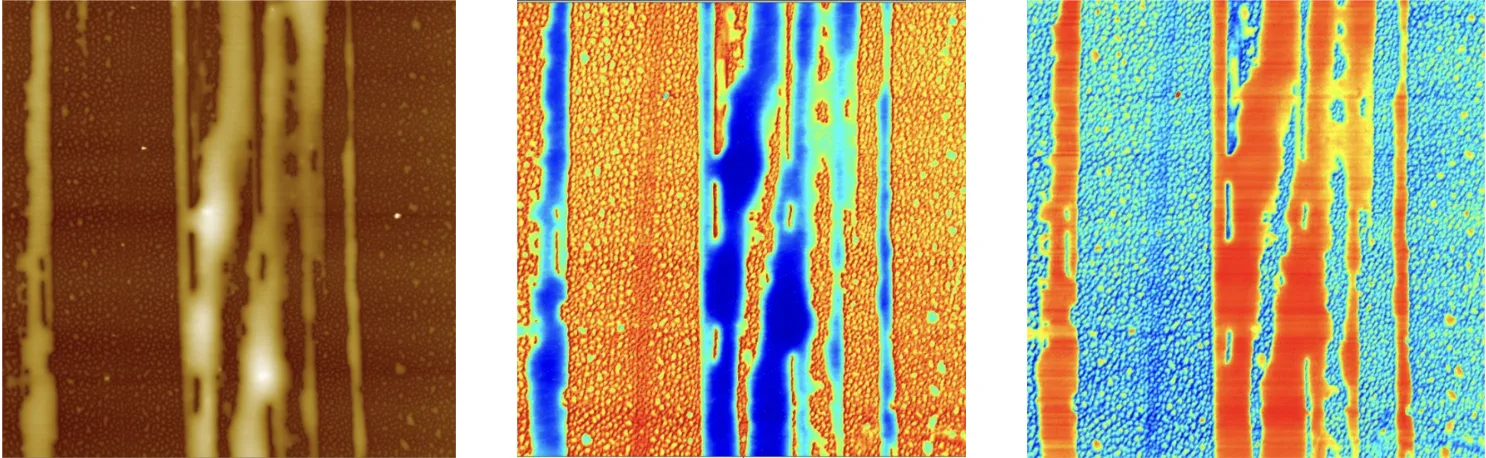
Results

Product note
Soft Interaction Control product note
Principle, key specifications and application examples in one technical document. We send it to you by e-mail.
FAQ
Frequently Asked Questions
What is Soft Interaction Control (Soft IC) in AFM?
Soft Interaction Control is the intermittent-contact mode of the Nano-Observer AFMs. At every point the tip touches the surface with a force set directly through the cantilever deflection, then lifts away before moving to the next point. It combines the direct force control of contact mode with the absence of friction of resonant (tapping) mode.
How is Soft IC different from tapping mode?
In resonant (tapping) mode the force is controlled indirectly, through the oscillation amplitude. Soft IC controls it directly with one parameter, the deflection, so the force is known and the same at every point. That makes mechanical and electrical measurements quantitative while still avoiding lateral forces.
Which measurements can be made in Soft IC?
Topography, stiffness, adhesion and Young’s modulus (Soft MEKA), resistance and current (Soft ResiScope), conductive AFM, piezoresponse (Soft PFM) and thermal properties (Soft SThM).
Which samples benefit from Soft IC?
Soft, sticky, fragile or loosely attached samples that contact mode would damage or drag: polymers, organic electronics, battery electrodes, nanotubes and particles, and biological samples.
Questions about Soft IC mode?
Ask the application scientists behind our AFMs and modes — about your samples, probes, set-up or which mode fits your measurement. We answer every message personally.