
Application fields
Key Features
Key Features of PFM
What our PFM offers
- High Sensitivity: Detect even the smallest piezoelectric responses
- Dual-Frequency Mode: Simultaneously map topography and piezoresponse
- Vector PFM: Measure both vertical and lateral piezoresponse components
- Spectroscopy Capabilities: Perform local hysteresis measurements
- Integration with Other Modes: Combine PFM with conductivity or mechanical property mapping
Why PFM on the Nano-Observer
- Superior Resolution: Our advanced PFM implementation offers unparalleled spatial resolution.
- User-Friendly Interface: Intuitive software makes PFM accessible to both experts and beginners.
- Versatility: Easily combine PFM with other AFM modes for comprehensive sample characterization.
- Cutting-Edge Research: Stay at the forefront of piezoelectric and ferroelectric research with our continuously updated technology.
Examples
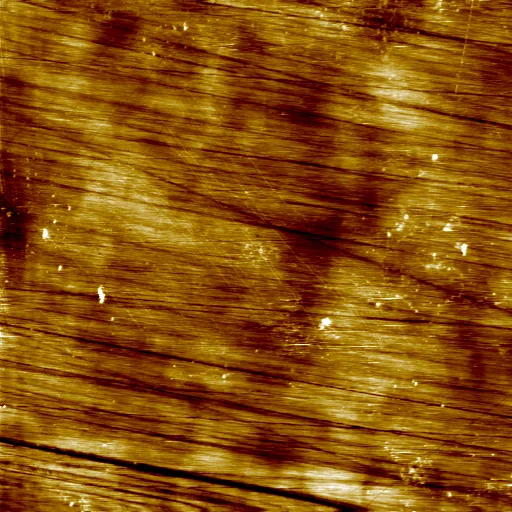
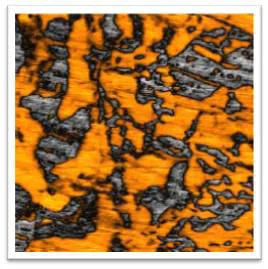
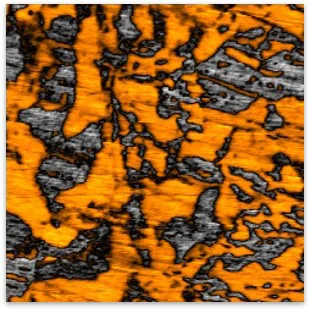
PZT sample, 10 µm — topography and PFM phase recorded together: the phase image shows the ferroelectric domains, independent of the surface relief.
How does PFM mode work?
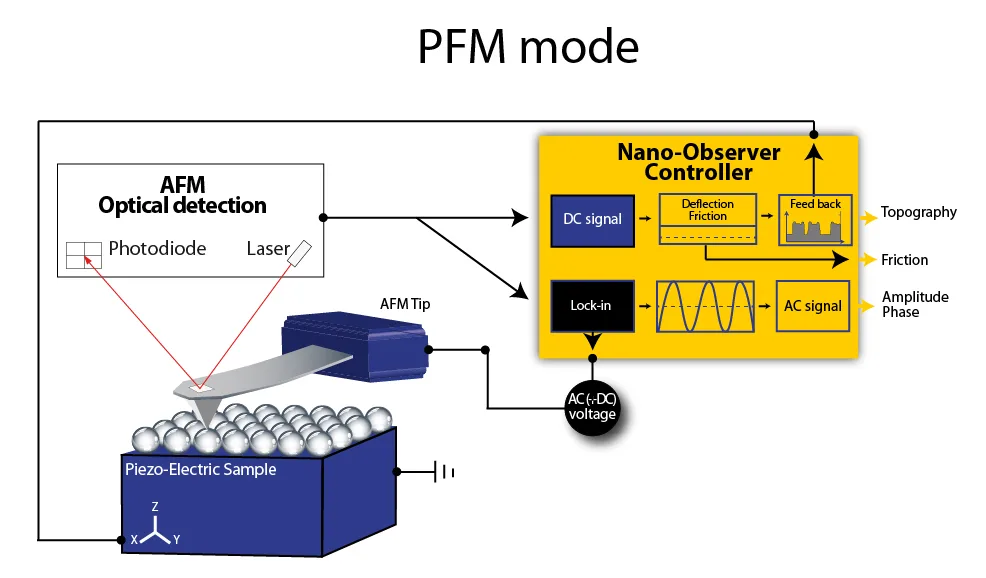
PFM operates by applying an alternating electric field to a sample through a conductive AFM tip. The sample’s piezoelectric response causes tiny deformations, which are detected by the AFM system.
This allows for:
- High-resolution mapping of piezoelectric domains
- Quantitative measurements of local piezoelectric coefficients
- In-situ polarization switching studies
Application Fields
Materials Science
- Characterization of ferroelectric thin films
- Study of domain structures in piezoelectric ceramics
- Investigation of electromechanical properties in composite material
Nanotechnology
- Development and optimization of nanoscale actuators and sensors
- Exploration of 2D piezoelectric materials
Energy Research
- Analysis of piezoelectric energy harvesters
- Study of ferroelectric solar cells
Biology
- Examination of piezoelectric properties in biological materials (e.g., bone, collagen)
- Investigation of electromechanical coupling in cell membranes
Data Storage
- Research on ferroelectric memory devices
- Domain writing and reading for potential data storage applications
Measurement
What a PFM measurement records
PFM is a contact-mode AFM technique: an AC voltage is applied to a conductive tip while it scans, and the sample’s piezoelectric response makes the surface oscillate under the tip. The oscillation is read out as two images recorded with the topography:
- PFM amplitude — the strength of the local piezoelectric response.
- PFM phase — the orientation of the polarization, which shows the ferroelectric domains independently of the surface relief (see the PZT example above).
With vector PFM, both the vertical and the lateral components of the response are measured. In spectroscopy, the voltage is swept at a fixed point to record local hysteresis loops and study polarization switching.
Probes for PFM
PFM needs a conductive tip in contact with the sample. Boron-doped diamond probes (DD-ACTA, DD-FORTA) and CS-A conductive diamond probes resist wear during contact scanning; Pt/Ir-coated ANSCM probes are the metal-coated alternative. See the probe selection guide.
PFM combined with other modes
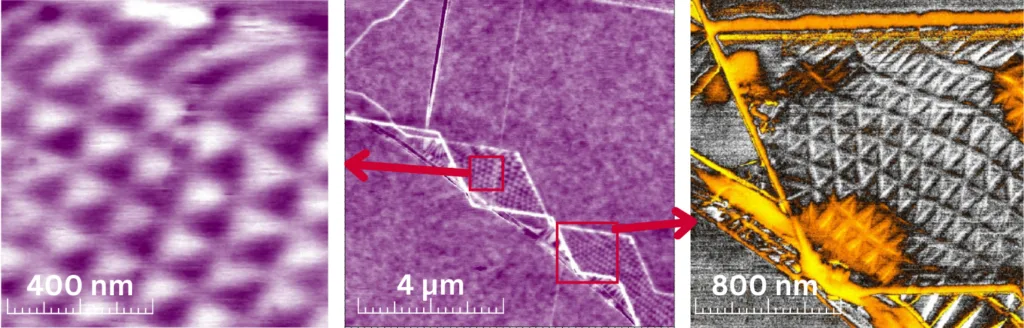
On the Nano-Observer, PFM can be recorded simultaneously with ResiScope™ (piezoresponse and resistance), on the same area as HD-KFM™ (as on the folded hBN example above), and as Soft PFM with Soft Interaction Control on fragile samples, without shear.
FAQ
Frequently Asked Questions
What is piezoresponse force microscopy (PFM)?
PFM is an AFM contact mode in which an AC voltage is applied to a conductive tip during scanning. The piezoelectric response of the sample makes the surface oscillate, and the amplitude and phase of this oscillation map piezoelectric and ferroelectric domains at the nanoscale, together with the topography.
What do the PFM amplitude and phase images show?
The amplitude shows the strength of the local piezoelectric response; the phase shows the orientation of the polarization, so the ferroelectric domains appear in the phase image independently of the surface relief.
What is vector PFM?
Vector PFM measures both the vertical and the lateral components of the piezoresponse, to reconstruct the orientation of the polarization in the plane and out of the plane of the sample.
Can PFM measure hysteresis loops and polarization switching?
Yes. In PFM spectroscopy the voltage is swept at a fixed point to record local hysteresis loops, and polarization can be switched in situ to study domain writing and reading.
Which samples can be studied with PFM?
Ferroelectric thin films, piezoelectric ceramics, composite and 2D piezoelectric materials, energy harvesters and ferroelectric solar cells, ferroelectric memories, and biological materials such as bone and collagen.
Which probe is used for PFM?
A conductive probe in contact: boron-doped diamond probes (DD-ACTA, DD-FORTA) or CS-A conductive diamond probes for wear resistance, or Pt/Ir-coated ANSCM probes.
Can PFM be combined with other AFM modes?
Yes. On the Nano-Observer, PFM can be recorded simultaneously with ResiScope (piezoresponse and resistance), on the same area as HD-KFM surface potential, and as Soft PFM with Soft Interaction Control on fragile samples.
Questions about PFM Mode?
Ask the application scientists behind our AFMs and modes — about your samples, probes, set-up or which mode fits your measurement. We answer every message personally.