Validating Nanoscale Conductivity in HA-MWCNT Rectennas
Terahertz (THz) technology is a frontier for non-destructive imaging, high-speed communication, and advanced surveillance. However, the practical application of THz sensors often requires wavelength selectivity—the ability to isolate specific frequencies within the electromagnetic spectrum. A groundbreaking study recently published in Materials Today Nano addresses this by utilizing horizontally aligned multi-walled carbon nanotubes (HA-MWCNTs) as resonant monopole antennas.
The Research: Precision Antennas at the Nanoscale
The research team, led by AlTakroori et al., developed an IR rectenna that achieves selective detection at 0.3 THz (1 mm) and 0.15 THz (2 mm). The key innovation lies in the quarter-wavelength monopole design. By using Focused Ion Beam (FIB) milling, the researchers cut the HA-MWCNTs to precise resonant lengths (100 µm and 200 µm, respectively). This tailored length accounts for the shortening of effective wavelengths caused by the dielectric loading of the silicon substrate.
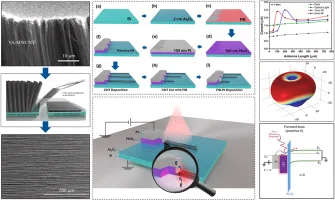
Graphical Abstract: Design and integration of horizontally aligned multi-walled carbon nanotubes with a Metal-Insulator-Semiconductor (MIS) diode for selective THz sensing.
Characterization Challenge: The Role of ResiScope
In such a complex fabrication process, verifying the electrical integrity of the CNT network is paramount. Standard Conductive AFM (C-AFM) often struggles when mapping highly conductive 1D structures (CNTs) embedded on insulating substrates (Si-Al2O3) due to noise or signal saturation. To overcome this, the researchers utilized the CSI NanoObserver AFM equipped with the proprietary ResiScope module.
Quantitative Evidence of Charge Transport
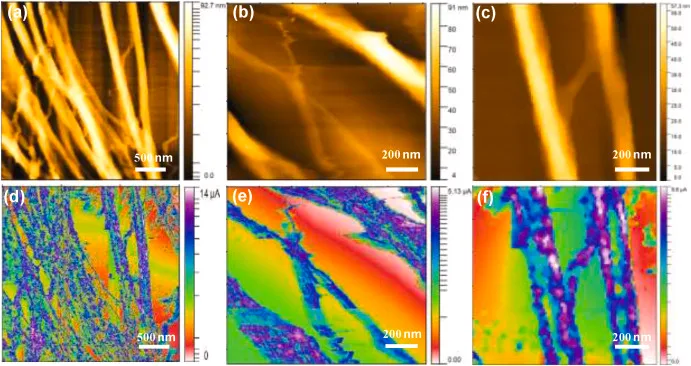
Using the ResiScope mode under a bias voltage of 0.1 V, the team successfully mapped the spatially resolved electrical conduction along the nanotubes. The current maps revealed distinct conductive pathways matching the CNT locations perfectly, confirming effective charge transport.
- High Current Values: Dense CNT regions exhibited stable currents between 9–14 µA.
- Substrate Contrast: The metrology tool clearly distinguished the conductive nanotubes from the insulating substrate.
- Uniformity: Topographical consistency (RMS roughness of ~30 nm) was validated alongside electrical mapping.
ResiScope Nanoscale Electrical Mapping: (a–c) Topography vs. (d–f) Current Mapping. The high-contrast pathways (9–14 µA) provide quantified proof of the CNT network’s electrical quality for rectenna performance.
Why ResiScope Matters for Advanced Material Research
The success of the ResiScope in this study stems from its ability to handle extreme resistance variations without losing sensitivity. For researchers working with nanotubes, nanowires, or 2D heterostructures, the ResiScope offers:
10 Decades Dynamic Measurement Range
0.1 V Bias Ultra-Low Voltage Precision
High Resolution Spatially Resolved Conductance
The research concluded that resonant CNT lengths boosted photocurrent response by up to 150%. These results pave the way for next-generation THz sensing technologies, from thermal imaging to remote sensing, all built on a foundation of quantified nanoscale electrical characterization.
Read the Full Publication at Materials Today Nano
Reference:
H. AlTakroori, S. Elsayed, A. Rezk, et al., “Horizontally aligned carbon nanotube-based rectenna for selective terahertz photodetection,” Materials Today Nano, Vol. 32, 2025, 100716. DOI: 10.1016/j.mtnano.2025.100716.