
Application fields
Key Features
Contact Mode
- High Resolution: Achieve atomic-scale imaging on suitable samples.
- Direct Force Measurement: Quantitative analysis of tip-sample interactions.
- Versatility: Compatible with various sample types and environments.
- Simultaneous Data Acquisition: Collect topography and friction data in a single scan.
- Established Technique: Well-understood methodology with extensive literature support.
Contact Mode AFM
Force Curves
Perform precise force-distance measurements to study:
- Adhesion forces
- Material elasticity
- Surface energy
Friction Analysis
Utilize Lateral Force Microscopy (LFM) to investigate:
- Nanoscale tribology
- Surface lubrication
- Material homogeneity
Environmental Control
Conduct experiments in various conditions:
- Controlled atmosphere
- Liquid environments
- Temperature variations
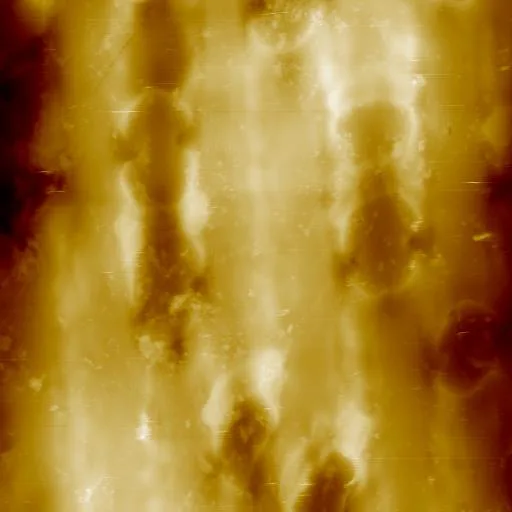
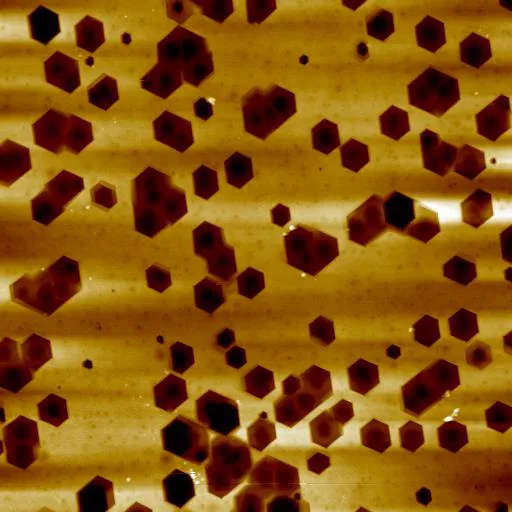
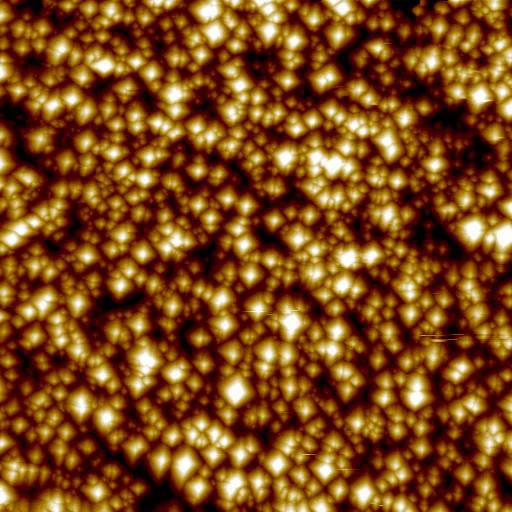
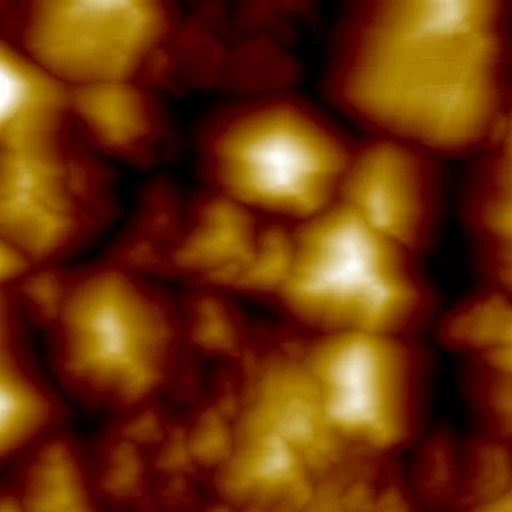
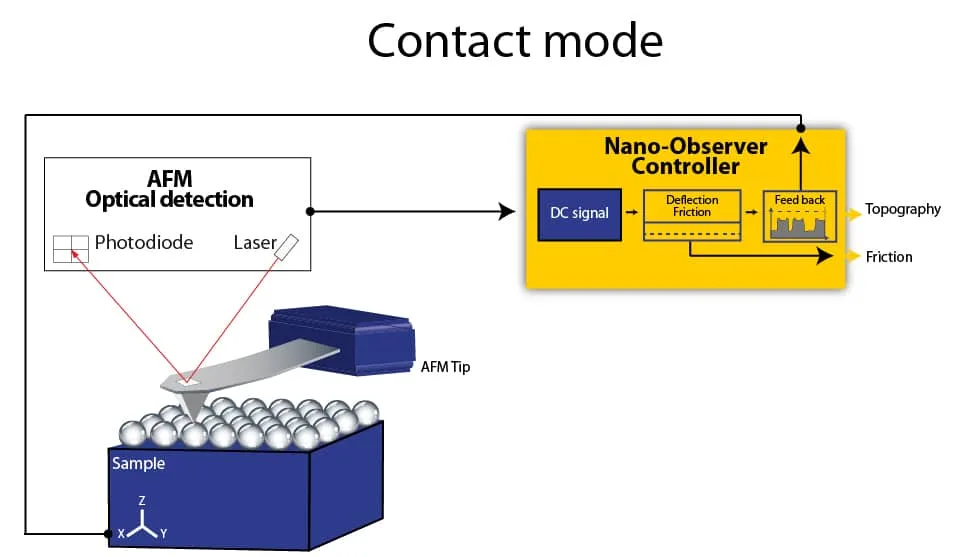
How does Contact Mode AFM work?
- Probe-Surface Interaction: A sharp tip attached to a cantilever is brought into direct contact with the sample surface.
- Constant Force: As the tip scans across the surface, a feedback loop maintains a constant cantilever deflection, ensuring consistent contact force.
- Laser Detection: A laser beam reflected off the cantilever’s back detects minute changes in its deflection.
- Topography Mapping: Vertical movements of the piezoelectric scanner, adjusted to maintain constant deflection, are recorded to create a topographical map.
- Friction Measurement: Torsional movements of the cantilever provide information about surface friction (Lateral Force Microscopy – LFM).
Questions about Contact Mode?
Ask the application scientists behind our AFMs and modes — about your samples, probes, set-up or which mode fits your measurement. We answer every message personally.