
Two field configurations
In-plane or out-of-plane magnetic field
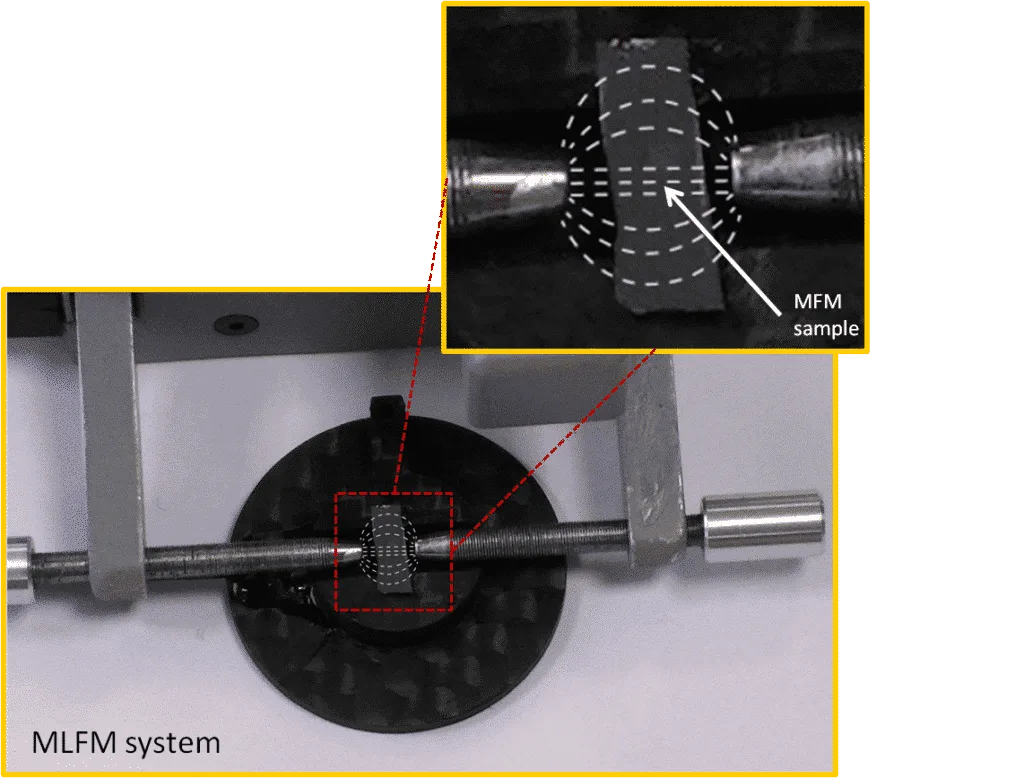
The VMFM applies a variable magnetic field to the sample while it is imaged in MFM mode — out-of-plane or in-plane, depending on how the two magnetic rods are placed.
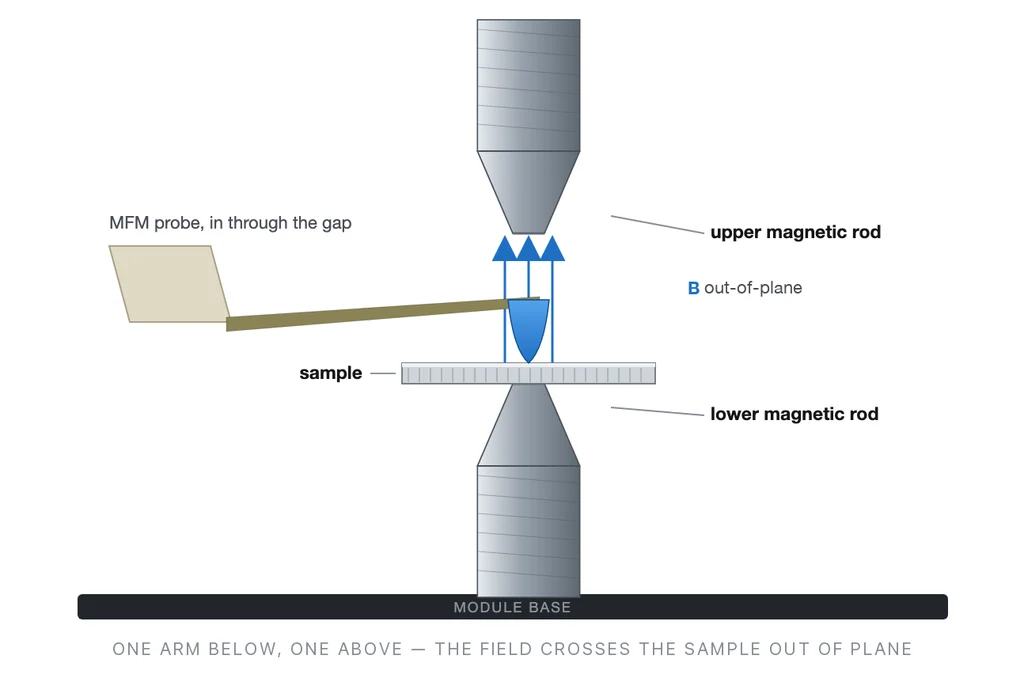
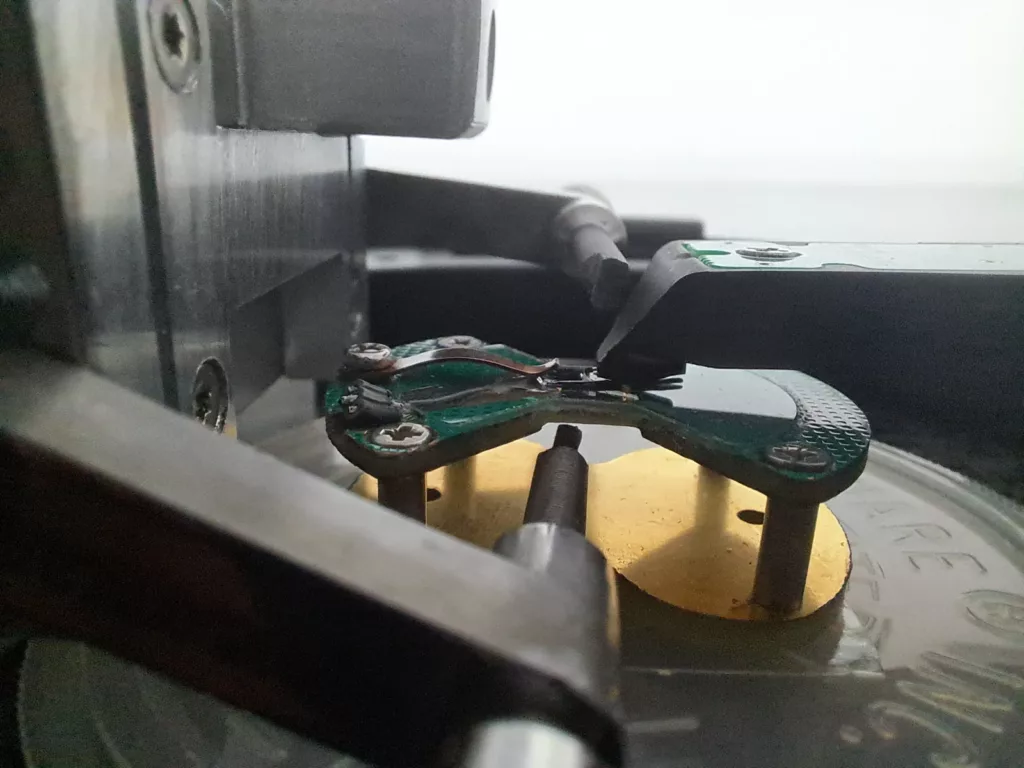
Out-of-plane field
One arm below, one above — the field crosses the sample out of its plane.
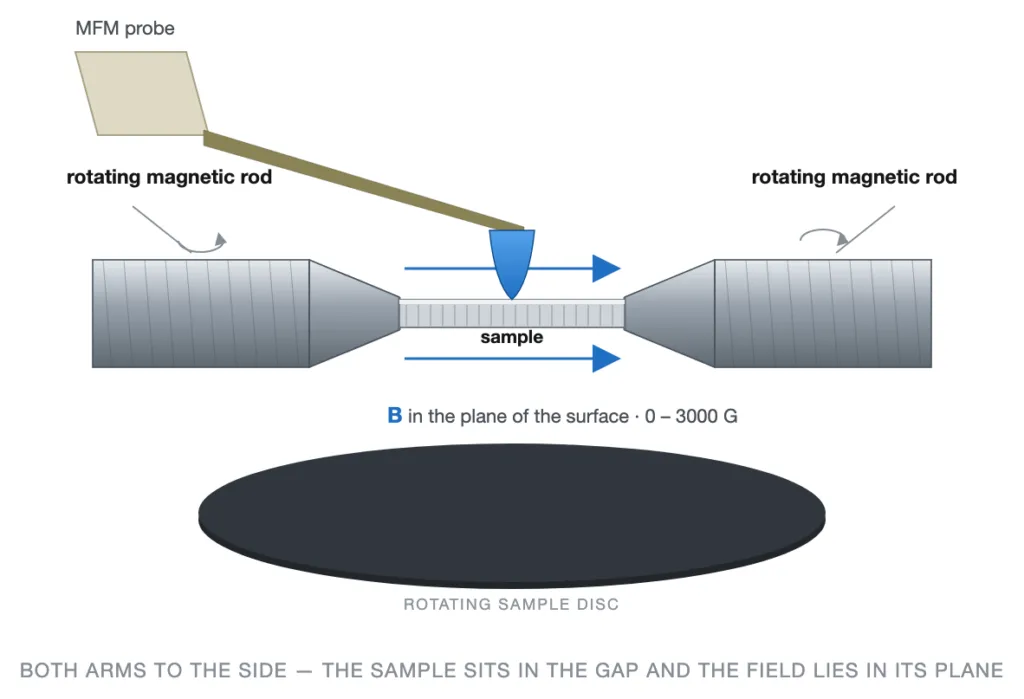
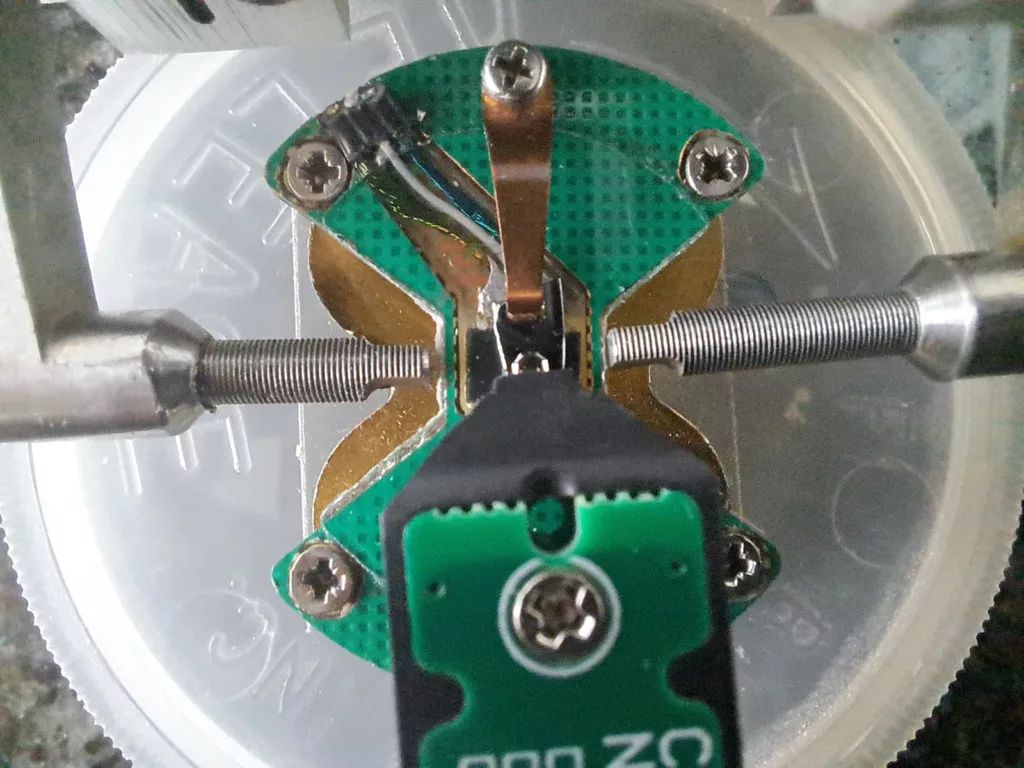
In-plane field
Both arms to the side — the sample sits in the gap and the field lies in its plane (0 – 3000 G).
Measurement
Structures under a varying field
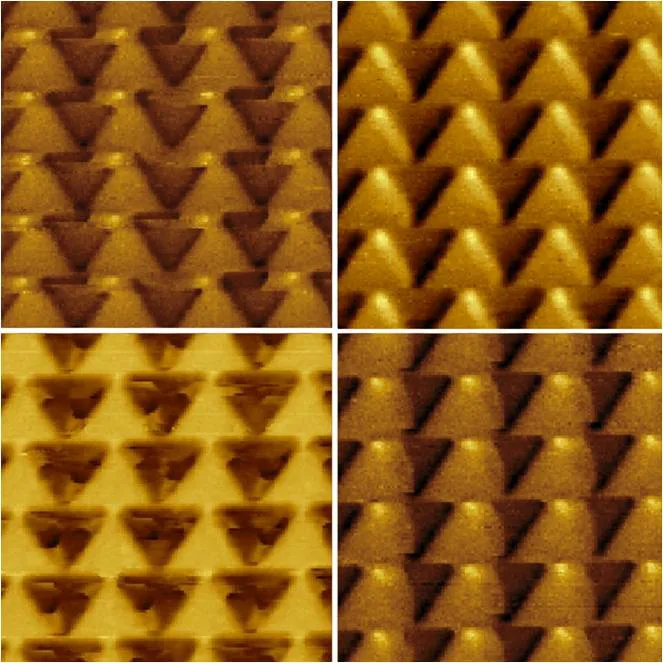
MFM of magnetic structures from 50 to 470 gauss, 3 µm scan.
Field variation during a scan
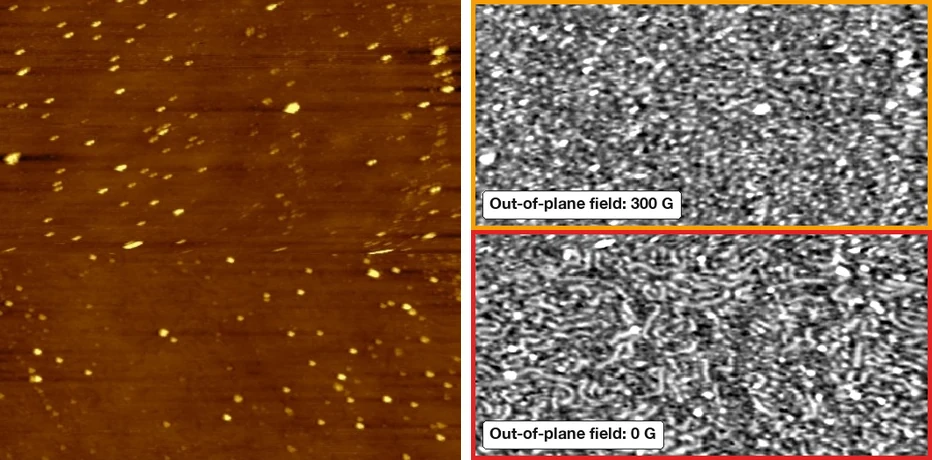
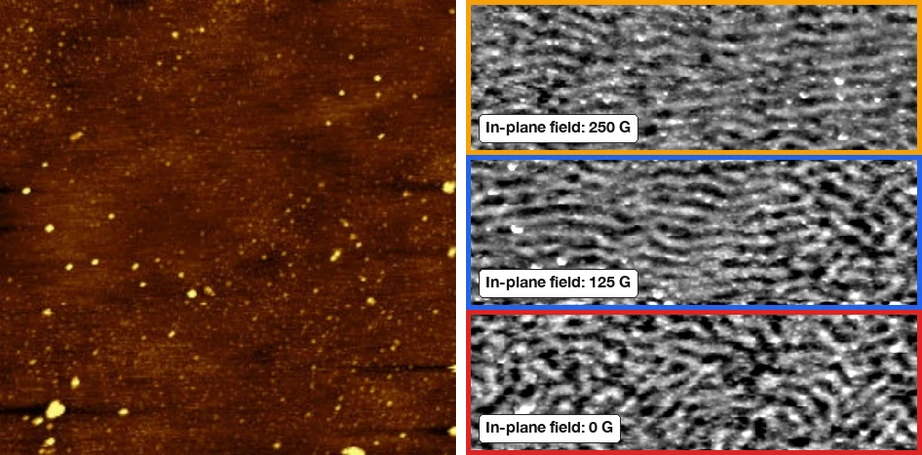
MFM images of a thin magnetic coating on silicon, recorded while the field was changed during the scan. Each region of the MFM image is labelled with the field it was scanned at, with the out-of-plane and the in-plane field option.
Out-of-plane field variation
Thin magnetic coating on Si, MFM with the out-of-plane field option. Left: topography. Right: MFM signal; the field was changed during the scan and each region is labelled with its field. Scan size: 10 µm.
- Upper half: 300 G
- Lower half: 0 G
In-plane field variation
Thin magnetic coating on Si, MFM with the in-plane field option. Left: topography. Right: MFM signal; the field was changed during the scan and each region is labelled with its field. Scan size: 5 µm.
- Top: 250 G
- Middle: 125 G
- Bottom: 0 G
Application fields
Data Storage Technology
- Study magnetic recording media under varying field conditions
- Investigate domain wall motion in next-generation storage devices
- Optimize magnetic bit patterns for increased data density
Materials Science
- Characterize novel magnetic materials and nanostructures
- Analyze magnetization reversal processes in thin films
- Study magnetic phase transitions and domain dynamics
Semiconductor Industry
- Evaluate magnetic properties of spintronic devices
- Investigate magnetic sensors and MEMS devices
- Perform failure analysis on magnetic components
Fundamental Physics
- Explore magnetization dynamics at the nanoscale
- Study topological magnetic structures like skyrmions
- Investigate magnetoelectric coupling in multiferroic materials
Key Features
- Dynamic Magnetic Imaging: Observe real-time changes in magnetic domains
- In-Plane Magnetic Field: Generate controlled magnetic fields up to 3000 Gauss
- No Sample Heating: Unique design eliminates current-induced heating
- High Resolution: Maintain nanoscale imaging capabilities during field application
- In situ Control: Adjust magnetic field strength and direction during experiments
- Seamless Integration: Designed for compatibility with Nano-Observer AFM systems
Sample : Magnetic triangles structures
Scan size : 6µm
Mode : MFM
Environment : VMFM
Benefits of VMFM
- Advanced Magnetic Studies: Perform dynamic magnetic characterization impossible with standard MFM
- Non-Invasive Analysis: No current-induced sample heating, preserving sensitive samples
- High Resolution: Maintain nanoscale imaging capabilities under applied magnetic fields
- Versatile Applications: Adapt to a wide range of magnetic materials and research questions
- User-Friendly Operation: Intuitive control of magnetic field parameters during experiments
Questions about the Variable Magnetic Field Module?
Ask the application scientists behind our AFMs and modes — about your samples, probes, set-up or which mode fits your measurement. We answer every message personally.