
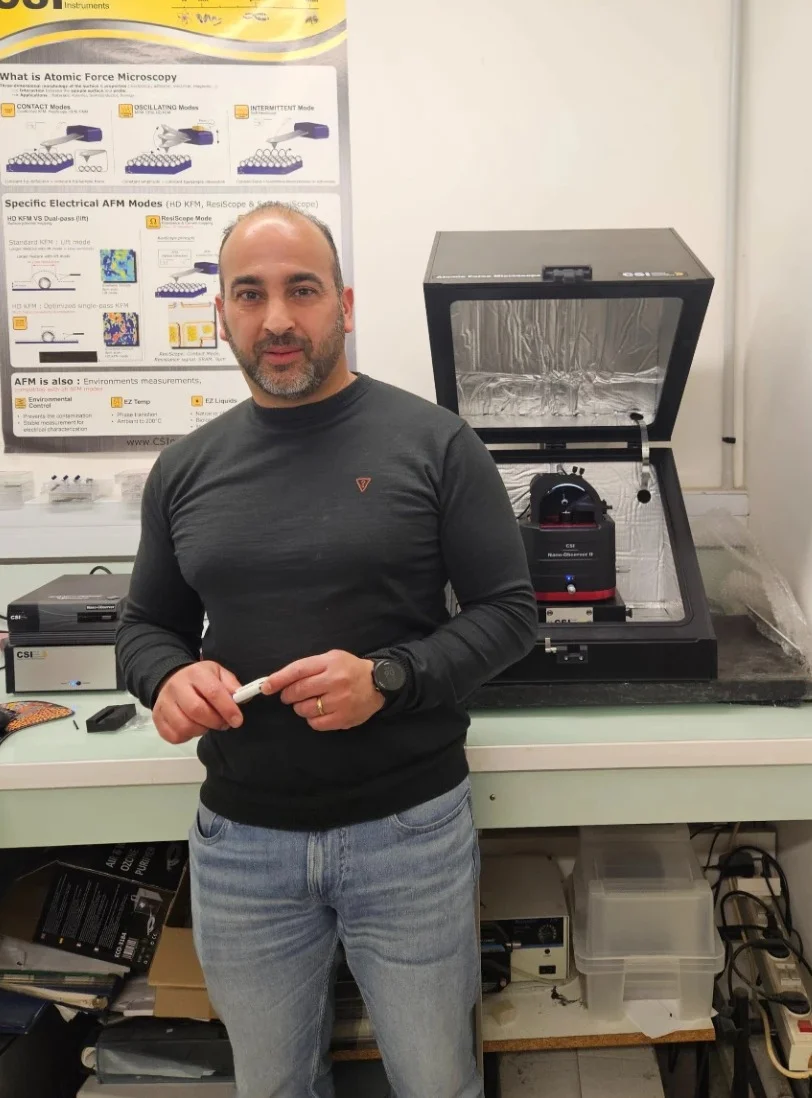
The lab
Block copolymer membranes with ordered nanochannels
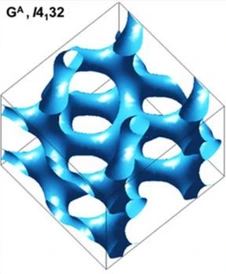
Dr. Karim Aissou’s group at the Institut Européen des Membranes (IEM, Univ Montpellier, ENSCM, CNRS) builds block copolymer films and membranes whose nanochannels are ordered as gyroids, cylinders or lamellae. The applications are water treatment, PFAS removal and ion transport.
Their AFM
The group first worked with a Nano-Observer (first generation). In tapping mode it shows the nanostructure at the film surface at each step of the process, from the as-cast film to the finished membrane. Ten papers with Nano-Observer images have been published since 2021.
The lab has now moved to the Nano-Observer II.
“The Nano-Observer AFM is an invaluable part of my research journey.”
Dr. Karim Aissou
Result
Gyroid nanochannels through the whole membrane
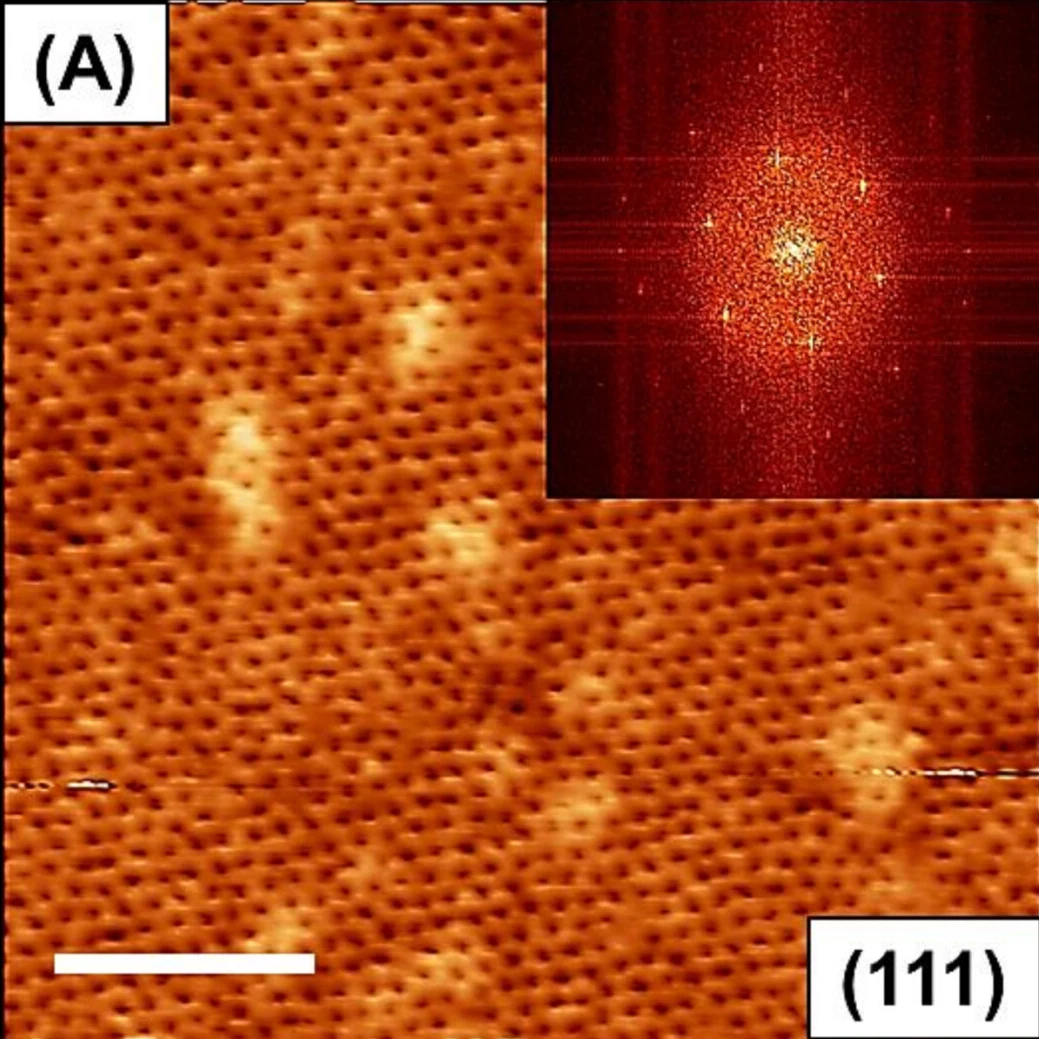
In the 2026 Journal of Polymer Science paper, anion-exchange block copolymer membranes with alternating gyroid nanochannels were made to remove PFAS from water. The Nano-Observer, in tapping mode, imaged the gyroid (111) plane at the membrane surface: a triangular pattern with a period of about 44 nm (Figure 1). Because the gyroid channels are continuous, PFOA reaches the ion-exchange sites across the whole membrane thickness, while disordered membranes take it up mainly near their surfaces.
Publications
Papers with Nano-Observer images
Found by full-text search of the papers (OpenAlex and HAL). Where we read the methods, the measurement is given.
- PFAS Removal by Anion-Exchange Block Copolymer Membranes Featuring Highly Ordered Alternating Gyroid NanochannelsJournal of Polymer Science, 2026Tapping mode: gyroid (111) plane at the membrane surface, period about 44 nm.
- Bio-based amines from urethane oligomer for tunable epoxy thermosetsPolymer, 2026
- Double Gyroid-Forming Hybrid Anion Exchange Membranes With Superior Mechanical PropertiesJournal of Polymer Science, 2025Tapping mode: film surface at each step of the process.
- Lithium iodide transport in double gyroid nanochannels formed by zwitterion-containing solid polymer electrolytesJournal of Polymer Science, 2024
- Square arrays of vertically aligned nanoporous cylinders from a linear ABC triblock terpolymerJournal of Polymer Science, 2023
- Nanoporous Double-Gyroid Structure from ABC Triblock Terpolymer Thick FilmsInternational Journal of Polymer Science, 2023
- Single-ion nano-features formed by a Li-containing block copolymer synthesized via PISAPolymer Chemistry, 2023
- A facile approach to modify cellulose nanocrystal for the adsorption of perfluorooctanoic acidCarbohydrate Polymers, 2023
- Rational design of SiBCN microstructures using direct photolithography of patternable preceramic photoresistsMaterials & Design, 2022
- Asymmetric Solvent-Annealed Triblock Terpolymer Thick Films Topped by a Hexagonal Perforated Lamellar NanostructureMacromolecular Rapid Communications, 2021
On the same AFM
Current maps on soft polymer films
Tapping mode shows the structure. On the Nano-Observer II, films like these can also be measured electrically, with two modes working together:
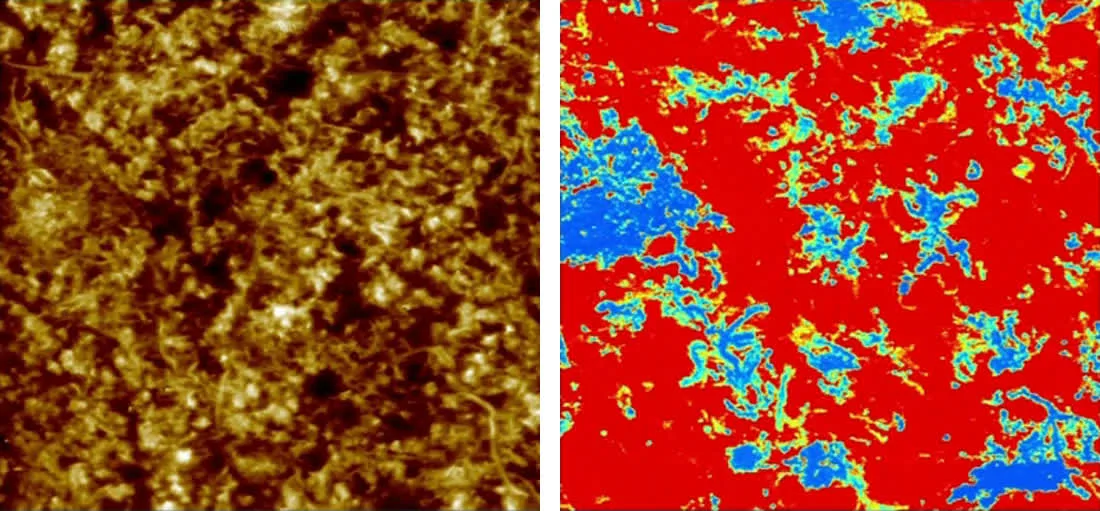
On the same area, HD-KFM™ III adds the surface potential, measured on the second cantilever eigenmode with a noise level below 1 mV.
Your samples
Measure your own samples on the Nano-Observer II
Send a short description of the sample and what you need to measure. The application team recommends a mode and can run test measurements.